EFSI & VHBP Webinar: Live-in Care in Some European Countries: How Do They Overcome Practical and Legal Obstacles?
July 9, 2026
EFSI & AHS Webinar: Strengthening Fair Recruitment for Migrant Workers in PHS
October 13, 2026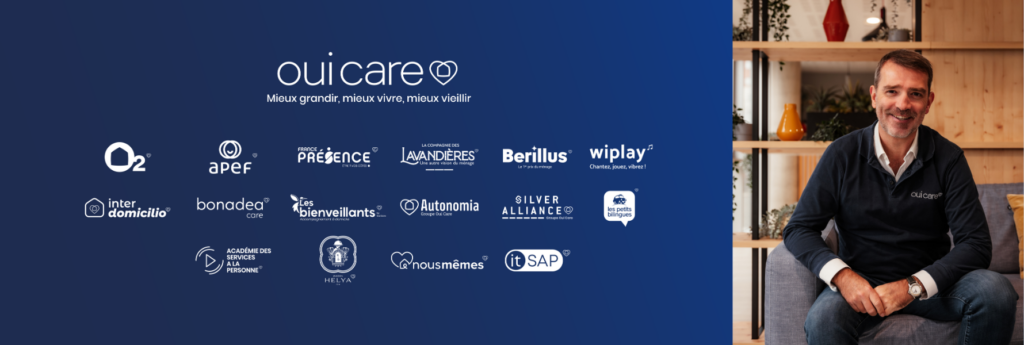
20 Years of EFSI: From Home Services to a Pillar of Europe’s Social Model
As part of EFSI’s 20th anniversary campaign, we are speaking with leaders from across the Personal and Household Services community about the sector’s evolution, its growing role in our societies and the challenges ahead.
In this interview, Guillaume Richard, Founder and CEO of Oui Care Group, reflects on 30 years of developing home services and shares his vision for the future of Personal and Household Services in Europe, from professionalisation and demographic change to European cooperation and the recognition of PHS as a strategic investment.
1. Oui Care Group is celebrating its 30th anniversary this year. Looking back over the past three decades, how has the Group evolved to respond to changing societal needs, and what achievements are you most proud of?
Thirty years ago, when I founded Oui Care, our ambition was simple: to make everyday life easier for families through high-quality home services. At that time, Personal and Household Services were often perceived as services of convenience. Today, it has become a key response to some of Europe’s greatest societal challenges.
Our societies have profoundly changed. People are living longer, families are evolving, more women are pursuing professional careers, family carers are under increasing pressure, and an overwhelming majority of people wish to remain at home for as long as possible. Home has become the place where independence, dignity, well-being and social cohesion come together.
Throughout these thirty years, our Group has constantly evolved to respond to these changing needs. What began with household services has progressively expanded into a unique ecosystem of complementary brands supporting people throughout every stage of life: childcare, education, household services, support for older adults, home care, autonomy, language learning and premium home services.
Today, through brands such as O2, Apef, France Présence, Les Bienveillants, La Compagnie des Lavandières, Les Petits Bilingues, Interdomicilio, Bonadea, Autonomia, Nous Mêmes, Berillus, Wiplay, Nounou Expert and Maison Helya, we support hundreds of thousands of families every year in France, Spain, Portugal and Switzerland.
But what makes me the proudest is not our growth. It is the impact we create every single day through the commitment of more than 25,000 professional carers who help people grow better, live better and age better at home.
These 25,000 carers are now recognised as professionals. Their jobs are no longer precarious, and they can think of building a career in our companies as a carer or as a manager. We have many incredible stories to tell. Some of our carers have even become entrepreneurs as franchisees!
Another important milestone was becoming a Mission-driven Company. This reflects a conviction I have held since the beginning: economic performance and positive social impact are not contradictory; they strengthen one another.
After thirty years, I am more convinced than ever that Personal and Household Services are no longer simply a sector of the economy. They have become an essential pillar of Europe’s social model.
2. France has long been recognised as the country with one of the most developed Personal and Household Services sectors in the EU. From your perspective, what are the key lessons from the French model, and what challenges remain to ensure the sector continues to grow sustainably?
France has undoubtedly developed one of Europe’s most structured Personal and Household Services sectors. But it would be unfair to present it as the European model. Belgium, for example, has also built a remarkable system, particularly through its service voucher scheme, which has successfully combined accessibility for households, job creation and a significant reduction of undeclared work.
The real lesson is that countries which have invested consistently in this sector have demonstrated that Personal and Household Services generate considerable economic and social value.
In France, one of the major drivers has been the tax credit for home services. By making declared services more affordable for families, it has encouraged formal employment, accelerated the professionalisation of the sector and supported the creation of hundreds of thousands of qualified jobs.
Beyond supporting families, these policies have proven to be powerful tools in tackling one of the sector’s biggest challenges: undeclared work.
Informal employment weakens workers’ rights, deprives them of social protection and training opportunities, creates unfair competition and ultimately limits service quality. It also represents a significant loss for public finances. Even with a 50% tax credit, it is still profitable for the State and, much more interestingly, financially speaking, than undeclared work.
The French and Belgian experiences demonstrate that ambitious public policies can create a virtuous circle. Families gain access to affordable, high-quality services. Professionals benefit from recognised careers and better working conditions. Companies invest in innovation and quality. Public authorities strengthen employment while reducing the informal economy. State is gaining money despite the tax credit.
Of course, every country has its own social protection system and cultural context. The objective is not to export one national model across Europe. Rather, it is to learn from successful experiences and adapt them to local realities.
The next challenge is equally important. We must continue to improve the attractiveness of our professions, to invest in skills and lifelong training, to embrace innovation while keeping people at the heart of our services, and to ensure that high-quality home services remain accessible to everyone who needs them.
Ultimately, investing in Personal and Household Services is not simply investing in one sector. It is investing in employment, gender equality, healthy ageing, family support and social cohesion.
3. Europe’s ageing population is increasing demand for home-based support and care services. In your view, what are the biggest priorities to ensure that people can age well at home while maintaining high-quality, accessible and person-centred services?
Ageing well at home is undoubtedly one of the greatest societal challenges Europe will face over the coming decades.
The vast majority of Europeans (90% in France) wish to remain in their own homes for as long as possible. Home is much more than a place to live. It represents independence, personal identity, family memories and social relationships. Helping people remain at home safely and with dignity should therefore become a shared European priority.
Achieving this ambition requires much more than providing care services. It requires building a comprehensive ecosystem capable of supporting people throughout the ageing journey: prevention, assistance with daily living, companionship, coordination with healthcare professionals, digital innovation and personalised support adapted to individual needs.
We also need to continue investing in people.
Artificial intelligence, digital platforms and connected technologies will undoubtedly improve the organisation of services, but they will never replace empathy, trust and human relationships. Technology should help professionals spend more time with people, not replace them.
Another priority is to recognise the essential contribution of informal carers who are often relatives. Across Europe, millions of people support ageing parents or vulnerable relatives while continuing to work. They are an invisible pillar of our healthcare and social systems. Yet, they often experience exhaustion, financial difficulties and emotional stress with too little support.
Helping informal carers means helping society. Helping them also means providing professional carers to do all the technical work, so they can focus on what matters the most. If they help too much, they do not have enough time to love, and no one should become the mother of their mother.
Finally, we must stop seeing ageing only through the lens of dependency.
People are living longer, healthier and more active lives. The challenge is therefore not simply to care for older people, but to enable them to remain active, connected and autonomous for as long as possible.
If Europe succeeds in combining professional home services, innovation, prevention and stronger support for carers, I am convinced we can transform demographic ageing from a challenge into an opportunity to build more caring, more inclusive and more resilient societies.
4. Many of the challenges facing the sector, from labour shortages and skills development to service accessibility and affordability, are shared across Europe. How can stronger cooperation between national stakeholders and European organisations help address these issues?
One of the greatest strengths of Europe is the diversity of its national models. Every country has developed its own approach to Personal and Household Services, shaped by its social policies, labour market and cultural context.
Rather than seeing these differences as obstacles, I believe we should see them as an opportunity to learn from one another. No country has found the perfect solution. France has developed an effective tax credit system. Belgium has successfully implemented its service voucher model. Other countries have pioneered innovative approaches to long-term care, vocational training, or support for informal carers.
The real challenge is to create more opportunities to share these experiences and to understand why certain policies have succeeded. This is precisely where organisations such as EFSI play an essential role.
They provide a platform where companies, federations, researchers and policymakers can exchange ideas, compare evidence and collectively promote solutions that have proven their value. European cooperation is also essential when addressing common challenges, such as workforce shortages.
Competition for talent is increasing across Europe. Improving the attractiveness of our professions will require better training, stronger career pathways, greater recognition and a renewed image of our sector. These are challenges that transcend national borders.
Finally, Europe has an important role to play in encouraging innovation. Whether through digitalisation, artificial intelligence, new models of care coordination, or social innovation, we should ensure that innovation always serves people, and not the other way around.
If we succeed in working more closely together, Europe will not only strengthen the Personal and Household Services sector. It will strengthen its capacity to respond to some of the biggest demographic and social challenges of the twenty-first century.
5. Collaboration between organisations across Europe is essential to share knowledge, exchange good practices and strengthen the voice of the Personal and Household Services sector. In your view, what are the greatest benefits of working together at European level, and how can this collaboration help shape the future of the sector?
Our sector is often rooted in local communities, but the challenges we face are undeniably European.
Ageing population, labour shortages, support for family carers, undeclared work, digital transformation and the professionalisation of care are issues that no country can solve alone.
This is why European collaboration is so valuable.
First, it enables us to learn much faster. Every successful innovation or public policy implemented in one country can inspire others and accelerate progress across Europe.
Second, working together strengthens the visibility and credibility of our sector.
Personal and Household Services are still too often perceived as a collection of individual activities rather than as a strategic economic and social sector. By speaking with one voice, we can better demonstrate our contribution to employment, gender equality, social inclusion, healthy ageing and territorial cohesion.
Third, European cooperation encourages innovation.
When entrepreneurs, researchers, public authorities and social partners exchange ideas, they create solutions that none of them could have developed alone.
Finally, collaboration reminds us that our common objective goes far beyond economic performance. We all share the same ambition: enabling more people to live independently, with dignity and quality of life, in their own homes. This shared purpose is what gives our European community its greatest strength.
6. As the CEO of one of Europe’s leading Personal and Household Services providers, what gives you the greatest confidence about the future of the sector, and what is the one change you would most like to see at European level?
What makes me optimistic is that Europe is becoming increasingly aware of the essential role our sector plays. For many years, Personal and Household Services were considered primarily as a response to individual needs. Today, they are recognised as part of the solution to some of Europe’s biggest societal challenges.
They enable parents to reconcile family and professional life.
They support older people who wish to remain at home.
They assist millions of informal carers.
They create local jobs that cannot be relocated.
They strengthen social cohesion.
This growing recognition gives me confidence.
However, if I could encourage one major change at the European level, it would be this:
I would like Personal and Household Services to be recognised as a strategic investment that is profitable rather than a cost.
Investing in our sector is not simply funding services.
It means investing in declared employment.
In women’s participation in the labour market.
In healthy ageing.
In prevention.
In social inclusion.
In the fight against undeclared work.
And ultimately, in the resilience of our societies.
Europe has an extraordinary opportunity to build a common vision of home-based services that combines economic performance, social innovation and human dignity.
I am convinced that organisations such as EFSI will continue to play a decisive role in making this vision a reality.
Because behind every service delivered at home, there is much more than practical assistance.
There is trust.
There is human connection.
And there is the possibility for everyone to grow better, live better and age better at home.