20 Years of EFSI: From Home Services to a Pillar of Europe’s Social Model
September 23, 2026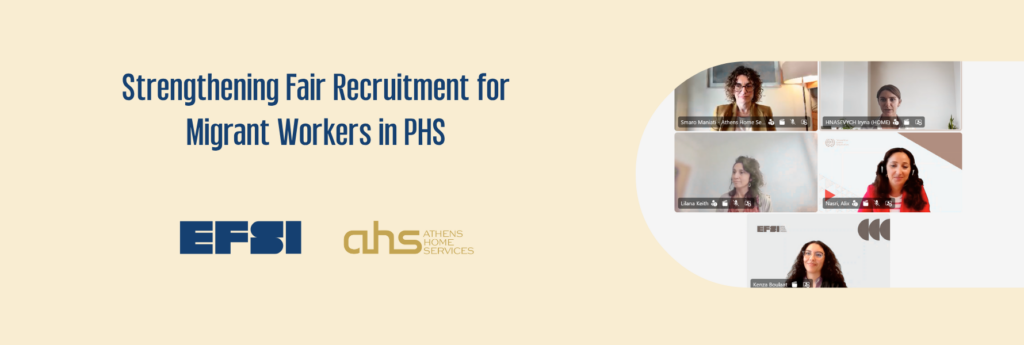
EFSI & AHS Webinar: Strengthening Fair Recruitment for Migrant Workers in PHS
As part of its 20th anniversary campaign, EFSI organised a webinar on 8 October 2026 exploring the role of agencies in the recruitment of migrant workers for Personal and Household Services (PHS). Bringing together perspectives from recruitment practice, migrant workers’ rights, international labour standards and EU policy, the discussion highlighted the challenges of opaque recruitment chains and the need for greater transparency and accountability.
Moderated by Kenza Boulaat, EFSI Policy Director, the webinar featured contributions from Smaro Maniati, Athens Home Services (AHS), Irina Lazarova, Berlin Consultation Centre for Migration and Decent Work, Lilana Keith, PICUM, Alix Nasri, International Labour Organization (ILO), and Iryna Hnasevych, European Commission’s Directorate-General for Migration and Home Affairs (DG Home).
When Recruitment Chains Put Workers at Risk
Recruitment can involve several agencies and intermediaries across countries, making it difficult to identify who is responsible for working conditions and compliance with the law.
The consequences can be severe. One example from Greece concerned a young woman who had entered the country legally with a visa but had paid €7,000 in intermediary fees and accumulated debt. Her legalisation was never completed, and her work was not declared: entering legally did not mean working legally. Her experience illustrates how recruitment practices can leave workers vulnerable while also exposing households to risks they may not fully understand.
As presented by AHS, responsible agencies can help prevent these situations through careful selection of partners, transparent contracts, preparation for both workers and households, and follow-up after placement. However, these efforts need to be supported by effective licensing, oversight and enforcement. It was also noted that Greek law already prohibits charging workers recruitment fees, but without effective sanctions, and that licences should be suspended or withdrawn when rules are broken, as is already the case in the Philippines.
Making Fair Recruitment a Shared Responsibility
Recruitment fees, misleading information and unclear contractual arrangements can contribute to debt, insecure employment and exploitation. These challenges are not limited to one country. Examples from Greece and Germany highlighted how complex recruitment arrangements can obscure responsibilities and leave workers uncertain about their rights, including in relation to working hours, wages and social security.
Addressing these risks requires more than rules on paper. Effective monitoring, accessible advice and remedies for workers, and cooperation between countries of origin and destination are essential. Households also need clear information about their responsibilities, while responsible agencies need a framework that recognises and supports fair recruitment practices.
From Standards to Effective Implementation
International standards, including ILO conventions on private employment agencies and domestic workers, provide an important foundation for fair recruitment. Key principles include protecting workers from recruitment fees, ensuring transparent contractual arrangements and preventing deception and coercion.
At EU level, legal migration pathways and initiatives such as the EU Talent Pool can help connect employers with workers from outside the EU. Yet fragmented rules and differences in national implementation remain challenges. Accessible information about rights, reliable support and effective enforcement are crucial to ensuring that legal recruitment pathways also lead to fair working conditions.
Building More Transparent Recruitment Pathways
The discussion highlighted a common priority: making recruitment chains more transparent and ensuring that responsibility cannot disappear between intermediaries. This requires cooperation between, public authorities, agencies, employers and organisations supporting migrant workers.
As the closing discussion underlined, legislation can only make a difference when it is effectively enforced. Fair recruitment is not only a safeguard for workers. It also helps protect households and creates a more level playing field for agencies committed to responsible practices.
On behalf of EFSI, we wish to thank our speakers for their insightful presentation and our participants for the enriching discussion.