PHS Social Dialogue Plenary Meeting Gather Stakeholders From Across Europe
June 17, 2026
20 Years of EFSI: From Home Services to a Pillar of Europe’s Social Model
September 23, 2026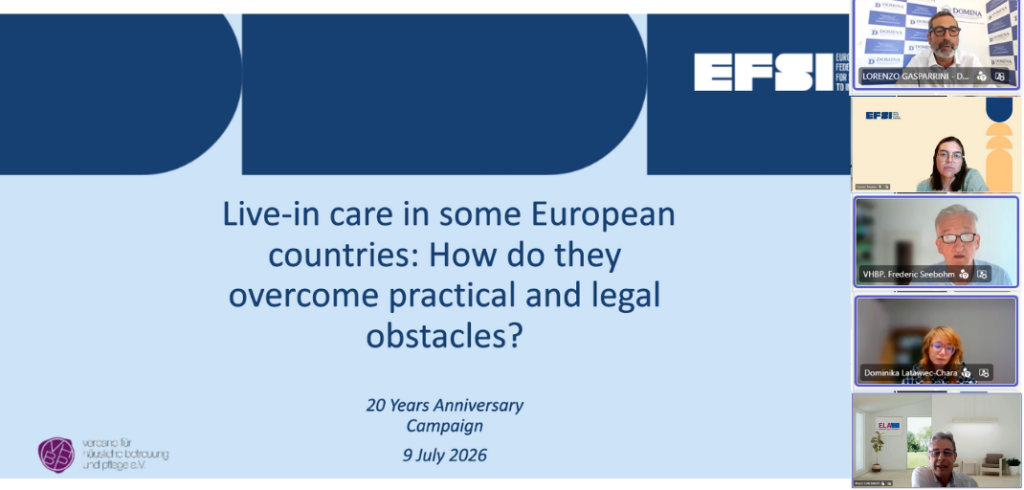
EFSI & VHBP Webinar: Live-in Care in Some European Countries: How Do They Overcome Practical and Legal Obstacles?
As part of EFSI’s 20th anniversary campaign showcasing the expertise of its members, EFSI organised a webinar dedicated to one of the most pressing issues faced by the Personal and Household Services (PHS) sector: the regulation of live-in care. The event placed a particular focus on Germany through the perspective of EFSI member, VHBP, while also bringing together speakers from the European Labour Authority (ELA), Stowarzyszenie Agencji Zatrudnienia – SAZ (Poland), and DOMINA (Italy) to discuss European trends, labour mobility and national regulatory approaches.
Opening the webinar, Leonor Tavares (Policy Director, EFSI) welcomed the participants and underlined the importance of exchanging national experiences to better understand the common challenges facing live-in care across Europe. As demographic change continues to increase demand for long-term care services, ensuring quality care while providing fair working conditions and legal certainty has become an increasingly important policy priority.
Setting the European Context
The webinar began with a presentation by Marco Cantalupi from the European Labour Authority (ELA), who introduced ELA’s Long-Term Care Report 2026 alongside the accompanying #EUFairCare information campaign. He highlighted how Europe’s ageing population and the growing preference for home-based care are increasing demand for live-in care across the EU.
While live-in care has become an essential pillar of many long-term care systems, the sector continues to face significant challenges, including its reliance on cross-border labour mobility, difficult working conditions, limited data and the persistence of undeclared work. During the discussion, participants also highlighted the importance of stronger cooperation between Member States to improve enforcement and support compliant providers.
Germany’s Search for Greater Legal Certainty
The central part of the webinar focused on Germany, with Frederic Seebhom from VHBP presenting the country’s evolving legal framework for live-in care. He explained that the sector currently relies on several legal models, including self-employment, posting arrangements and direct employment, but continues to face significant legal uncertainty.
Frederic Seebhom outlined the German government’s proposed reforms on self-employment and “employee-like” status, which could provide greater legal certainty from a social security perspective and help distinguish compliant providers from illegal ones. At the same time, participants discussed concerns regarding additional pension costs and the need to ensure that future legislation remains both practical and affordable.
The discussion also highlighted that clearer legal frameworks are essential to reducing undeclared work, with examples from Austria and Switzerland illustrating how legal certainty could support a more transparent labour market.
Cross-Border Labour Mobility and the Posting of Third-Country Nationals
Dominika Latawiec-Chara from SAZ then examined the legal framework governing the posting of Third-Country Nationals (TCNs) from Poland to other EU Member States, using Germany as a practical example.
The presentation clarified the distinction between two separate legal issues: the right to work and the right of residence. While Third-Country Nationals (TCNs) who are legally employed in Poland may generally be posted to another Member State without requiring an additional work permit, questions remain regarding residence requirements, particularly the application of the so-called Van der Elst visa.
Dominika also discussed the European Commission’s infringement procedure against Germany concerning the Van der Elst visa. Germany requires third-country nationals who have already undergone immigration checks and hold a residence permit or long-stay visa issued by another Member State to apply for this visa before providing services in Germany. According to the Commission, this requirement is incompatible with EU rules on the free movement of services and the rights of legally resident third-country nationals. The issue is particularly relevant for Ukrainian women posted from Poland to Germany to work in the live-in care sector. It remains to be seen whether the Commission will take further steps against Germany.
Although the outcome remains uncertain, participants welcomed recent positive signals suggesting that greater legal clarity may soon emerge in this area.
Italy’s Experience Highlights the Value of Social Dialogue
Providing a different national perspective, Lorenzo Gasparrini from DOMINA presented Italy’s long-established framework for regulating domestic and live-in care through collective bargaining. He explained how the national collective agreement helps ensure clear working conditions and workers’ rights, provides regularly updated minimum wages, and establishes structured job classifications based on the tasks performed by workers. He also highlighted the role of bilateral bodies, such as Ebincolf, in supporting professional training, skills certification, and welfare services for both workers and employers.
Lorenzo Gasparrini also presented several proposals developed by DOMINA to encourage declared work, including fiscal incentives and awareness campaigns to tackle undeclared employment. The discussion that followed emphasised that while national systems differ across Europe, social dialogue remains essential to developing sustainable solutions that balance the needs of workers, employers and households. Participants also reflected on emerging challenges such as digital platforms and artificial intelligence, stressing that innovation should be accompanied by appropriate regulation and continued cooperation across the sector.
Continuing the Dialogue on Live-in Care
Closing the webinar, Leonor Tavares thanked all speakers and participants for their valuable contributions. The discussions illustrated both the diversity of national approaches to live-in care and the common challenges shared across Europe, including labour shortages, legal uncertainty, cross-border mobility, and the fight against undeclared work.
As part of its 20th anniversary celebrations, EFSI will continue to showcase the expertise of its members through dedicated actions, fostering dialogue and sharing good practices that contribute to the development of sustainable, high-quality Personal and Household Services across Europe.
On behalf of EFSI, we wish to thank our panellists for their insightful presentation and our participants for the enriching discussion.