AIDialogue: EFSI’s latest EU-funded project officially launched
April 28, 2026
AIDialogue partners strengthen capacity on AI, algorithmic management and social dialogue
June 10, 2026
Highlights from the Webinar: Home Care & Domestic Work in Italy: DOMINA’s Perspective
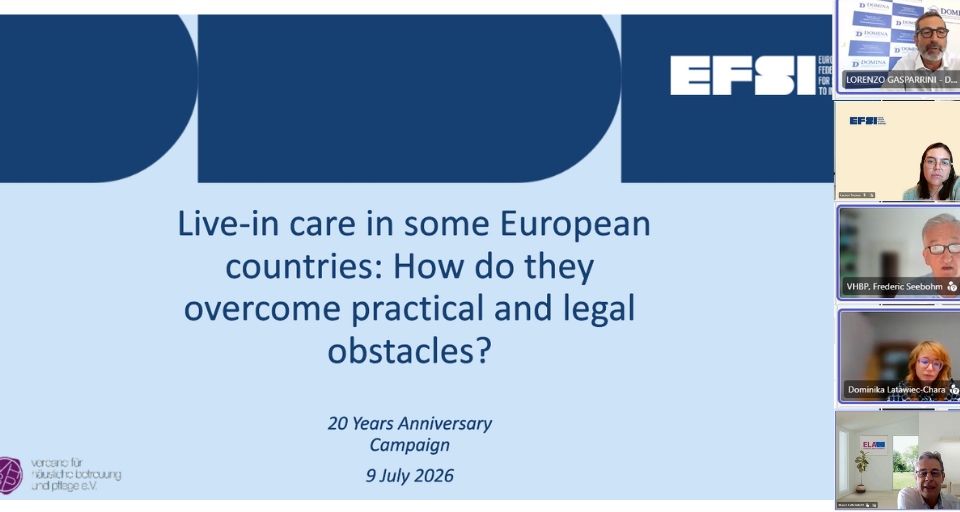
On 28 May 2026, EFSI hosted a webinar as part of its 20th anniversary campaign and the monthly member focus on its Italian member, DOMINA (Associazione Nazionale Famiglie Datori di Laboro Domestico). This webinar was designed to shared DOMINA’s perspective on the Home Care & Domestic Work in Italy and gathered participants from across Europe.
The discussion was focused on showcasing DOMINA’s work for the development of the PHS Sector in Italy, but also with a European and International vision.
Introducing DOMINA and its role in the PHS Sector
Lorenzo Gasparrini (General Secretary, DOMINA) first introduce DOMINA and its missions and objectives. Founded in 1994, DOMINA represents and supports households that hire domestic workers, and ensures families can navigate the legal and administrative complexities of becoming employers.
In addition to being an active member of EFSI, DOMINA is also taking part in key EU and international projects with the objective of serving as a real European and Global hub of expertise for the development of the sector, especially through the professionalisation of the domestic care workforce. Rebeca Gasparrini (Project Manager, DOMINA) explained how their participation in such projects allow them to represent the Italian perspective on several important topics, like the intra-EU labour and third country nationals mobility in home-based care (through the MobileCare and the Mobile Project), and on training and regulation (with the CAPABLE and WHOMEIN projects). They are also an active actor outside of Europe, with the International Cooperation Project emPoWeReD II in Tanzania and Zanzibar where they are supporting the capacity building and offer workshops on ethical recruitment and workplace monitoring.
The role of the Collective Bargaining Agreement in supporting the PHS sector in Italy
Lorenzo Gasparrini shifted the conversation on the major role DOMINA played in developing and securing the Collective Bargaining Agreement in Italy together with another employers’ association – FIDALDO – and four trade unions – Filcams CGIL, Fisascat CISL, Uiltucs UIL, and Federcolf. He showcased the main elements of the latest Collective Agreement for Domestic Work in Italy, and explained the main purpose of such an agreement, regulating domestic work and protect the workers. The agreement regulates on topics, such as:
- The classification of workers’ average wages depending on their tasks
- The regulation of working hours
- Annual, sick, and vocational training leave
- A thirteenth month’s salary
- A periodic change in minimum wage
Key findings from DOMINA’s 2025 Annual Report on Domestic Work
DOMINA launched the National Observatory on Domestic Work in Italy to capture essential information on the sector in 2020. The 2025 edition was presented by Massimo De Luca (Director, National Observatory on Domestic Work in Italy) showcasing some interesting trends from 2024.
- Data shows that the total number of persons involved in the PHS sector in Italy exceeds 3.3 million (combining both regular and irregular workers and employers) proving that this sector is one of the most significant, yet also one of the most vulnerable in the Italian labour market;
- In 2024, the proportion of carers officially surpassed that of housekeepers (50.5% carers; 49.5% housekeepers), highlighting the growing need for care services as a result of an ageing population;
- In Italy, as in most European countries, domestic and care work continues to be carried out mainly by women (88.9%), rather than men (11.1%), and by migrants (68.6%, increasingly from third countries), rather than Italians (31.4%).
- Undeclared work remains widespread, due to both immediate and structural causes, such as costs, paperwork, and permits.
Both Massimo De Luca and Lorenzo Gasparrini insisted on the need to pursue the efforts to reduce undeclared work and shared DOMINA’s call to the government to introduce a tax deduction on the annual cost of domestic work and increase reimbursement for social security contributions.
The future of Domestic Work and Care: Reflections from VESTA 2026
To further address the reality of the domestic work and care sector in Italy, DOMINA launched its flagship event, VESTA, bringing together key stakeholders from the Italian care sector and beyond. The idea behind VESTA is to create a network of relationships and opportunities as part of a process of growth, discussion, and development within the sector, where stakeholders can benefit from expert knowledge.
On 15th May, the third edition gathered more than 1,200 participants and 80 exhibitors, including EFSI. The focus was on the impact of digital technologies and artificial intelligence on the domestic & homecare sector, with the presence of start-ups, new tools for care at home, and key stakeholders of the Italian care economy.
More information about DOMINA can be found on their website. To learn more about VESTA and see some of the highlights of this 2026 edition, check their website.
On behalf of EFSI, we want to thank DOMINA for the valuable discussions and to all the participants for their attention and their questions.