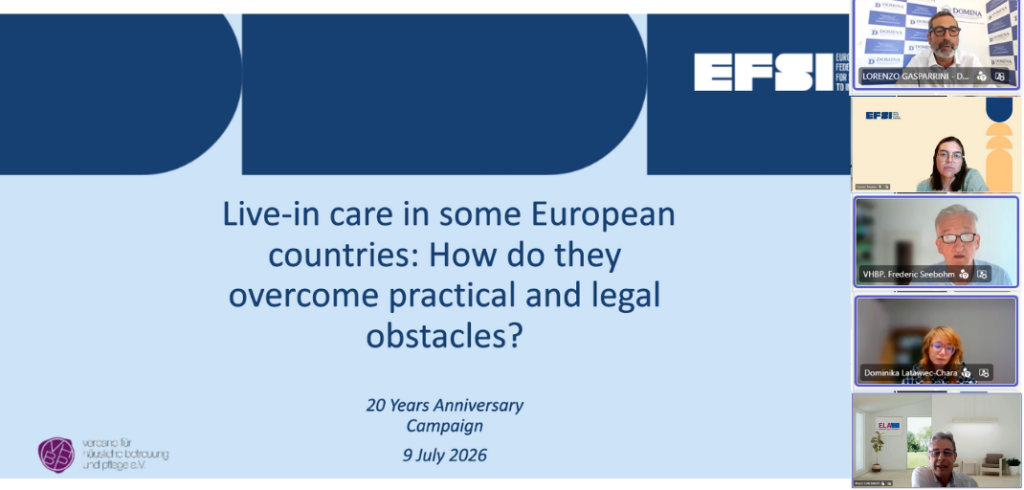
Webinar of the PHS Network on Collective Bargaining: Enhancing job quality in domestic and home care sector
April 10, 2026
AIDialogue: EFSI’s latest EU-funded project officially launched
April 28, 2026
Spanish Study Visit – EFSI & AESPD: Understanding the impact of recent legislative developments in the home care sector in Spain


On 14 and 15 April 2026, the European Federation for Services to Individuals (EFSI) organised a study visit in Madrid with its Spanish member, AESPD, under the framework of the Scale-Up project, to explore the impact of recent legislative developments on the home care sector in Spain. The event brought together representatives from service providers, workers’ organisations, and user groups to exchange perspectives and deepen understanding of the sector. Discussions were structured to reflect the diversity of actors involved and to provide a comprehensive overview of how the system functions in practice, highlighting both achievements and current challenges.
Tuesday 14 April 2026
Current Realities and Key Challenges in Spain’s PHS sector
The first session provided an overview of the Spanish home care sector, focusing on its legal framework, structure, and current challenges. Spain’s system is mainly shaped by the Dependency Law (Law 39/2006 of 14 December) and the law regulating the employment relationship of domestic and homecare (Royal Decree 1620/2011 of 14 November). While recent reforms have strengthened labour rights for domestic workers, including improved access to social protection, the sector continues to face structural issues such as labour shortages, a decline in registered workers, and a high prevalence of undeclared work. Public provision remains insufficient, with limited resources and coverage, placing pressure on families to organise care themselves. The sector also continues to rely heavily on women, often in precarious conditions, highlighting persistent gender inequalities and the need for a broader societal shift in how care work is valued.
The Voice of Migrant Workers on the PHS sector in Spain
The perspective of migrant workers underscored the gap between legislative progress and everyday realities. Although reforms have improved formal rights, many workers still face difficulties accessing training and stable employment conditions. The cost of formal employment remains a barrier for families, limiting the impact of these reforms in practice. The panellists stressed the importance of creating incentives that encourage formal hiring, both to improve working conditions and to ensure access to social protections. Overall, the discussion highlighted that significant care needs remain unmet and that both workers and employers require stronger support mechanisms to transition towards a more formal and sustainable system.
Tuesday 15 April 2026
Institutional Perspectives on Recent PHS Reforms in Spain
This session focused on institutional perspectives and policy implementation. Spain’s decentralised system allows regional authorities to introduce their own measures, such as tax incentives for hiring home care services, although these are not available nationwide. The example of the Madrid region illustrated how such initiatives can support families and promote formal employment, but also revealed limitations in outreach and accessibility. Efforts to professionalise the sector through specialised training and employment services were presented as positive steps, though their impact remains uneven across the country.
From Policy to People: Effects of PHS Reforms on Care Recipients
Discussions then turned to the impact of reforms on care recipients and families. Despite the role of service providers in facilitating access to care and creating employment, many families still rely on undeclared work arrangements due to cost. This exposes both workers and care recipients to risks and undermines the quality and safety of services. Public support systems remain underfunded, with limited coverage and long waiting times. At the same time, care responsibilities continue to fall disproportionately on women, affecting their participation in the labour market and overall well-being. Stakeholders emphasised the need for stronger financial support, including tax incentives and broader national measures, to make care more accessible and to reduce undeclared work. They also pointed to the importance of aligning policies with the real needs of users and simplifying administrative procedures to ensure inclusiveness.
Closing Session
The event concluded by reaffirming the importance of continued dialogue and knowledge exchange at the European level. Participants highlighted that while Spain has made progress in strengthening labour rights and recognising the importance of care, significant gaps remain in terms of funding, accessibility, and formalisation. Addressing these challenges will require coordinated efforts, increased investment, and policies that support both families, service providers, and workers. The study visit marked an important step in building a shared understanding of the sector in Spain, with future discussions planned to further discuss solutions and promote sustainable, high-quality care systems.
On behalf of EFSI, we wish to thank our panellists who exposed their expertise and participated in such a rich discussion, and a heartfelt thank you to the audience for their attention and their questions.
Additional information in Spanish can be found on the website of our member AESPD.